
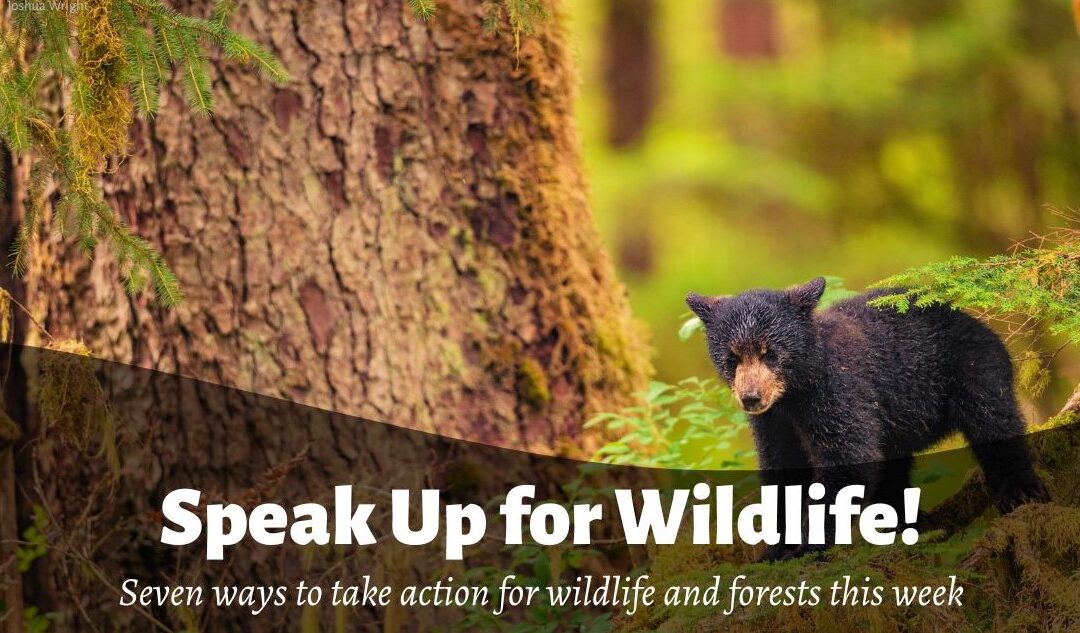
It may still be chilly outside, but February is heating up with several opportunities to voice your support for wild lives and wild places. Below, we list 7 ways you can take action: from submitting public comments on wolf, bear, and caribou hunting, to signing petitions for old growth forests and recognizing animal sentience.
Join us during the month of love to show some extra love for B.C. wildlife!

The B.C. government is accepting public input until February 13 on changes to 3 hunting regulations for wolves, caribou, and black bears. We’ve got a guide to help you submit your feedback below.
Proposal 1 — Extend wolf hunting open season in Tweedsmuir Park This proposal would remove the special, shorter wolf hunting season in the portions of management units 6-1 and 6-2 within Tweedsmuir Provincial Park, extending wolf hunting by 3.5 months.
Pacific Wild’s stance: Killing more wolves isn’t the answer. Extending the wolf hunting season in Tweedsmuir Park would set a troubling precedent for predator management in parks.
Proposal 2 — Allow caribou limited entry hunting in the north Peace This proposal would end the current full closure on caribou hunting in the Peace region and would introduce a limited entry hunt for 5-point bull Northern Mountain caribou in management units 7-50, 7-51, 7-52, and 7-54 from August 15 to September 30.
Pacific Wild’s stance: Why push more caribou to the brink? Uphold the precautionary principle. Reopening caribou hunting, even on a limited-entry basis, adds risk to populations already stressed by habitat loss, climate change, genetic bottlenecks, and cumulative industrial impacts.
Proposal 3 — Extend black bear hunting season on private land in the Lower Mainland This proposed change would add an August 1–31 black bear hunting season on private land in the Lower Mainland of B.C. (management units 2-2 to 2-19).
Pacific Wild’s stance: Prioritize coexistence over killing. Allowing a black bear hunt during peak foraging increases the risk of higher mortality and mistaken killing of dependent young. We support the use of existing tools and proven prevention measures that provide more targeted and accountable ways to address agricultural conflicts.
Take action! Click the button below for a list of talking points and a guide on how to submit public comments for each of these proposals.

Oppose old-growth logging before February 22
Teal Cedar plans to log a 7-hectare block of ancient yellow cedar forest just 30 metres from the ridge line of the headwaters of the Fairy Creek watershed, where old-growth logging has been deferred until September 30, 2026 following the request of Pacheedaht First Nation and widespread public action. The Fairy Creek deferral protects only about half of southern Vancouver Island’s largest remaining unprotected old-growth forest, and logging cut block 8027 would remove some of its most ancient trees while fragmenting a rare, high-productivity ecosystem.
Take action: Click the button below for a list of talking points and instructions on how to submit public input.
Add your signature to save ancient forests in B.C. Two important petitions are currently seeking signatures to support strengthening protections for old growth forests throughout B.C. Let’s help them get to 10,000 signatures!
A petition led by scientists Dr. Suzanne Simard and Dr. Rachel F. Holt calls on the Province of British Columbia to fundamentally reform forest stewardship by protecting remaining old-growth forests, supporting Indigenous-led conservation, and transitioning to a sustainable, locally focused forest economy grounded in ecosystem health.
A petition from the Save What’s Left Conservation Society is calling for the B.C. Premier to appoint a new Minister of Forests who is committed to long-term sustainability of B.C.’s old-growth forest resources of British Columbia, and for the Government to establish an independent, joint commission of inquiry with Indigenous governments into overestimation of British Columbia’s timber inventory and overharvesting of British Columbia’s forest resources.

It is clear that animals feel a range of emotions just like humans, including pleasure and pain; yet the Canadian Government still classifies animals as property rather than sentient beings. A House of Commons petition—drafted by scientists, researchers, and animal advocacy organizations, and authorized by MP Elizabeth May—is calling upon the Parliament of Canada to pass legislation that recognizes animals as sentient beings. The petition has already gathered 6,700 signatures, and the more the better to encourage a government response!
Sign the petition by March 17 and let the government know you support stronger animal welfare legislation.