
There’s something quite satisfying about restoring nature and making a very tiny part of the world better. I suppose I’ve always known that, but it really struck home when we purchased the place we were going to retire to 15-years ago.
We were still working fulltime, but my husband said we had to think ahead. His plan was to get a house that “needed a bit of work.” He found one: it had a leaking roof, no working heat, no potable water, few electrical outlets, and a rather large number of unwanted “furry friends” and huge nests of carpenter ants living in every wall.
My husband gets to work
The property, too, was in disrepair. Small buildings storing used dog food bags, old toilet seats, previously enjoyed brake pads, and Styrofoam meat trays littered the grounds along with buried carpets, linoleum tiles, and old plumbing. Trees had been used to secure guy wires and pulleys, hold up tree forts, and hold down tarpaulins.
Despite all this, the house had “good bones and a pretty view” so we bought it. It took a few years as we pieced together our energy, our time and our money but, eventually we fixed it all, with a little help from some professionals.
Although my husband is a builder and a farmer, we knew little about landscaping, so we decided to hire some experts to tackle that job.
A permaculturalist gets to work
A permaculturalist drew up a plan giving us a garden that paid attention to the path of the sun, the existing native soils, and ideas around sustainability. She designed a circular driveway that curves down to the house, sweeps over to the carport and goes around the huge Douglas fir in the front yard. She planned a dry riverbed to contour the sweeping driveway which would also pick up winter runoff and direct it to a pond where fish could frolic and birds wash their wings; a herb garden close to the house to encourage its use; and lots of native plants that need little encouragement to thrive.
Only one final neglected area in a hidden corner of the property needed our attention now. For the past decade, we had been using it to pile the dead branches and leaves, blackberry and ivy tendrils, and the spindly holly trees we’d taken down. The pile is called a hügelkultur if you’re savvy to landscape restoration terms. The berm was now sufficiently desiccated and was squashed and buried with a few loads of topsoil.
A Garry Oak restorationist gets to work
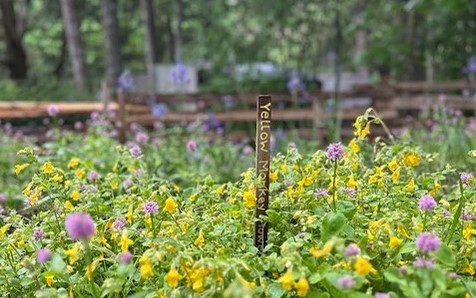
We wanted a Garry oak meadow, a unique ecosystem that goes hand in hand with our Coastal Douglas fir ecosystem, so we hired Mr. Hunter Jarratt. It was a sunny enough spot, he agreed, so he drew up a plan and got to work. He ordered more soil and then spread a type of cardboard on the area in hopes that it would suppress the non-native plants that littered the original site. Then he spread lots of seeds and bulbs that had beautiful names such as camas and monkeyflower, nodding onion and barestem biscuitroot, spring gold, and sea blush, white fawn lily and—of course—Garry oak acorns.
It only took eight months before we were rewarded with a profusion of blue, pink, yellow, and white flowers. But it wasn’t just us who admired the new plantings. Butterflies and other pollinators buzzed around flowers I was just beginning to be able to name. Birds came by and feasted on salmonberries and then drank from the pond in the yard and we couldn’t be happier.
Nature gets to work
Finally, we had completed our project of taking a tired and sadly abused part of the world and creating a little native oasis. It’s not just for our pleasure, but for the ones who crawl and flap and hum and buzz: our own native species who deserve us to care more about where they can live and thrive.
If you want to know more about our landscaping process, and perhaps learn how you too can restore your garden with nature in mind, come to my slideshow.
—
Pamela Walker will share her story of restoring a property through permaculture and preserverance as part of the Ladysmith Saltair Garden Club Speakers’ Series. Thursday, September 17, 7 pm, at the Eagles Hall, 921 1st Ave, Ladysmith, BC.