
Courtesy of the Times Colonist
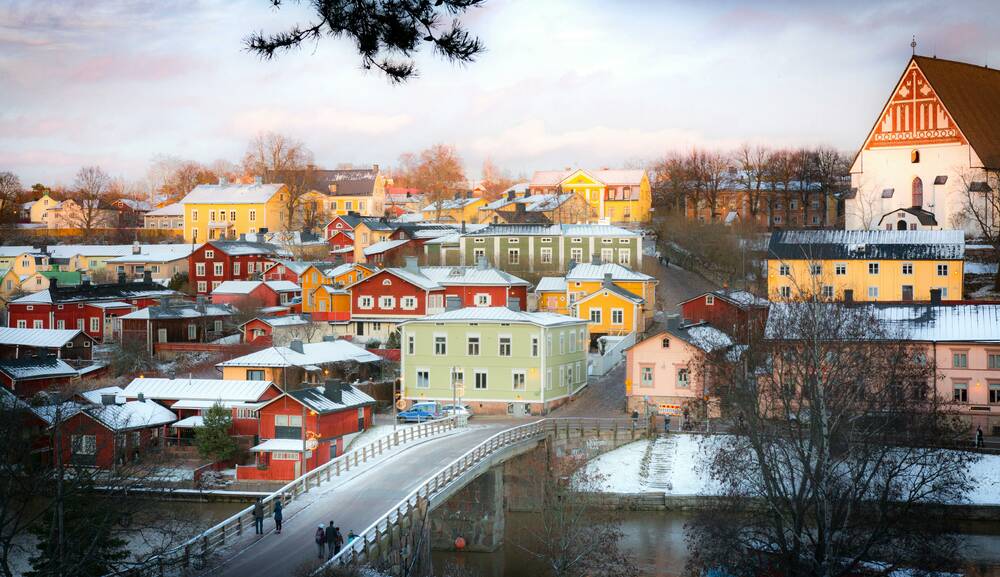
Photo: A view of colourful houses in Porvoo, Finland. Nordic countries lead happiness rankings, according to the World Happiness Report. Paul Theodor Oja via Creative Commons Licence
What can Canada learn from other countries about achieving well-being, happiness and a good quality of life?
As the 2023 World Happiness Report noted, people “increasingly think of well-being as the ultimate good,” and “more and more people have come to believe that our success as countries should be judged by the happiness of our people.”
This is particularly important right now because the new Liberal government has just established a cabinet committee on quality of life and well-being. Its mandate is to consider “ways to improve community safety and health, advance reconciliation with Indigenous Peoples, and augment the overall quality of life and well-being of Canadians.”
The obvious place to start is the Nordic countries.
The 2025 report, with data from 2024, was released in March. The report finds that Nordic countries “lead the happiness rankings. Finland, Denmark, Iceland and Sweden are still the top four and in the same order.” In comparison, Canada ranks 18th — down from 6th in 2013 — and the U.S. 24th.
This situation is so clear and consistent that in the 2020 report the authors devoted a whole chapter to exploring what they called Nordic exceptionalism.
What they found is that “the most prominent explanations include factors related to the quality of institutions, such as reliable and extensive welfare benefits, low corruption, and well-functioning democracy and state institutions.
Furthermore, Nordic citizens experience a high sense of autonomy and freedom, as well as high levels of social trust towards each other.”
Contrast that with what is happening in the USA, which seems to perfectly fit the 2020 report’s description of a low-trust society trapped in “a vicious cycle where low levels of trust in corrupt institutions lead to low willingness to pay taxes and low support for reforms that would allow the state to take better care of its citizens.”
The 2023 report went on to discuss how to measure a nation’s happiness and the factors that lead to increased happiness.
At its simplest, the authors noted, “the natural way to measure a nation’s happiness is to ask a nationally representative sample of people how satisfied they are with their lives these days.”
More particularly, they add, countries will only achieve high levels of overall life satisfaction “if its people are also pro-social, healthy, and prosperous.” (By “pro-social,” they mean “the outward- facing virtues of friendship and citizenship.”)
They cautioned that it is not enough to just look at average happiness, but at those who have low life satisfaction (or misery) and “to consider well-being and environmental policy dimensions jointly in order to ensure the happiness of future generations.”
The way to prevent misery and protect the quality of life of future generations, they suggest, is to establish and implement human rights, including the rights of future generations.
The 2023 report noted that the key factors that “explain the differences in well-being around the world, both within and among countries … include physical and mental health, human relationships (in the family, at work and in the community), income and employment, character virtues including pro-sociality and trust, social support, personal freedom, lack of corruption, and effective government.”
Notably missing from this list is the environment, but nobody who has been following the growing crisis of climate change, biodiversity loss and pollution, and the links between poverty and unhealthy environments can be in any doubt that our well-being and quality of life is also linked to the quality of our natural and built environments.
Hence the urging, noted above, to jointly consider well-being and environmental policy. In the 21st century, that means ensuring the sustainability of the Earth’s natural systems that are threatened by our pursuit of economic growth rather than quality of life, well-being and happiness.
It is to be hoped that the new cabinet committee on quality of life and well-being will look at the lessons to be learned from the World Happiness Report, and in particular from the Nordic countries.
They — and the government as a whole — should take a lesson from Thomas Jefferson, who noted in 1809: “The care of human life and happiness and not their destruction is the first and only legitimate object of good government.”
thancock@uvic.ca
Dr. Trevor Hancock is a retired professor and senior scholar at the University of Victoria’s School of Public Health and Social Policy