
Courtesy of the Times Colonist
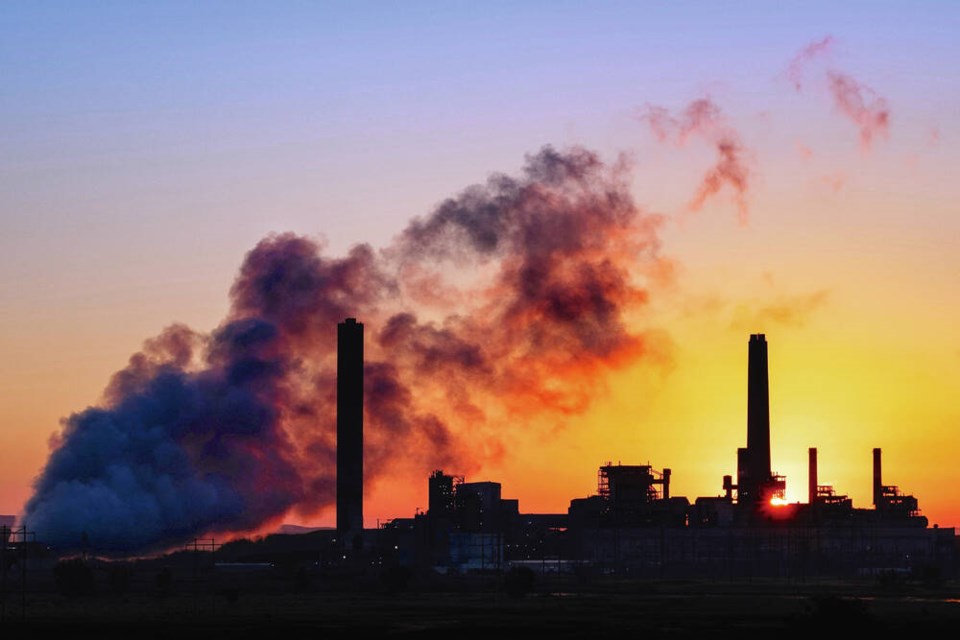
Photo: A coal-fired power plant in Glenrock, Wyoming. There is a growing awareness that our current economic system is broken, and cannot be fixed in a way that enables “business as usual” to continue, writes Trevor Hancock. THE ASSOCIATED PRESS
Earth For All is the title of a September 2022 report from the Transformational Economics Commission to the Club of Rome.
It is also “an international initiative to accelerate the systems-change we need for an equitable future on a finite planet.”
Given its roots in an economic analysis, it unsurprisingly focuses on the economy, calling for “an upgraded economic system,” because “the dominant economic model is destabilising societies. And the planet.”
The urgency of this economic transformation is highlighted by two articles published this month.
First, in an article published in Science Advances, Dr. Katherine Richardson and her colleagues have done the first comprehensive review of all the planetary boundaries that were first proposed in 2009.
They examined nine key Earth systems and concluded “six of the nine boundaries are transgressed, suggesting that Earth is now well outside of the safe operating space for humanity.”
In addition, they noted, we are close to breaching the boundary for ocean acidification, and already cross the boundary in some regions for air pollution. Moreover, they added, “The transgression level has increased for all boundaries earlier identified as overstepped.”
The only boundary we do not transgress is for the “hole” in the ozone layer. There, things are slowly improving, thanks to strong and rapid international action within two years of when the problem was identified in 1985 — which only goes to show that we can make positive change when we put our minds to it.
The second article, in Lancet Planetary Health, looked at 11 high-income countries (of which Canada is one) that succeeded in reducing their CO2 emissions while growing their GDP — a situation known as “decoupling”’ emissions from GDP growth.
While on the face of it, that seems a good thing, Jefim Vogel and Jason Hickel found that in reality, the rates of emission reductions fall far short of their legally binding CO2 emission-reduction commitments under the 2015 Paris Accord.
On average, they said, at that rate it will take more than 220 years for those countries to get their emissions down to an acceptable level.
Meanwhile, they found, they would emit 27 times their fair share of the planet’s remaining carbon budget.
If high-income countries are to achieve the needed emissions reductions, they concluded, “A crucial step is to stop the pursuit of aggregate economic growth and instead pursue post-growth approaches oriented towards sufficiency, equity and wellbeing.”
That, in essence, is also the central message of a May 2023 report from the World Health Organization’s Council on the Economics of Health for All. Their central premise is that “Alongside a healthy and sustainable environment, human health and wellbeing must be the ultimate goal of economic activity.”
The Earth For All report reflects the same concerns. It suggests “we should be largely agnostic about growth — it depends on what is growing.”
So “yes” to growth in wellbeing, but “no” to growth in material footprints, which need to shrink.
The report takes aim at the “winner takes all” economy and instead proposes “a commons-based wellbeing economy.”
They propose three big changes: “A Citizens Fund to distribute universal basic dividends generated from fees on wealth extraction” (Alaska’s Permanent Fund provides a model), “regulating finance to invest in strategies that address inequality, climate change and other crises” and cancelling unfair international debt.
Call it what you will — a Wellbeing economy, a Doughnut economy, a steady-state economy, de-growth — there is a growing awareness that our current economic system is broken, and cannot be fixed in a way that enables “business as usual” to continue.
In fact, business as usual leads inexorably to growing disruption of the Earth’s natural systems, growing inequality, and all the instability and societal breakdown that can result from those conditions.
When it comes to understanding the economy in relationship to our society and the planet, the World Wide Fund for Nature said it simply and well in its 2014 Living Planet report: “Ecosystems sustain societies that create economies. It does not work the other way round.”
The economic transformation we need begins with that simple understanding, a recognition that the economy must serve the people and respect the bio-physical limits of the Earth.
To act otherwise is, in the end, suicidal.
thancock@uvic.ca
Dr. Trevor Hancock is a retired professor and senior scholar at the University of Victoria’s School of Public Health and Social Policy