
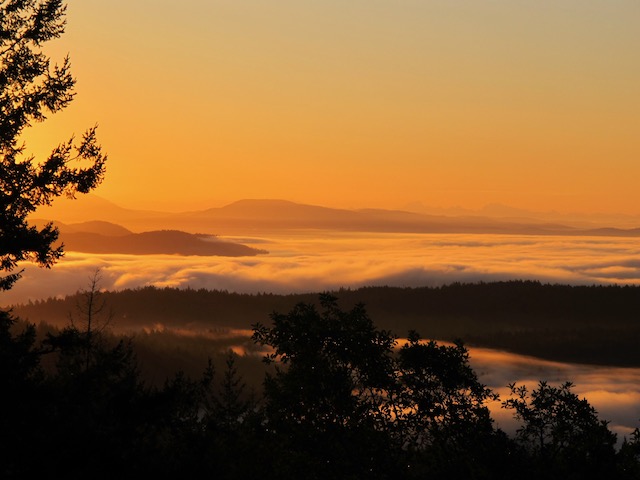
Fifty years ago, BC took a bold step to save our islands from “exploitation by real-estate developers and speculators,”* passing the Islands Trust Act, with its famous mandate “to preserve and protect” the Trust Area. Most islanders know that this act is what keeps our natural beauty and rural character largely unspoiled. Yet few are aware that these legal protections are now being dismantled by trustees sworn to uphold them.
The immediate threat is a revised Trust Policy Statement (TPS), which could become law within months. Our TPS sets the bar that Official Community Plans (OCPs) and major bylaws must meet. The existing one has stood for decades. So might this new one—but only if the BC government approves it.
The proposed Trust Policy Statement has already passed “first reading” by Trust Council (all 26 trustees) and could become law within months. We’re being told that consultation with public and First Nations was done during “Phase 1” in 2019, and now it’s time to finish the job. There was indeed broad outreach back then. More than 1600 people gave input at open houses, information booths, on ferries and online. The public’s top priorities were 1) connection to nature, and 2) strengthening the Trust’s protections.* Main public concerns were ecosystem damage, water scarcity, too much tourism and clear-cutting. These findings were summarized in the report “What We Heard.”
A draft TPS based on the consultation was ready for first reading by Trust Council in July 2021. But it didn’t get that far. Just days before Trust Council was set to debate it, Salt Spring trustee Laura Patrick (who now is also Trust Council Chair) issued a statement on behalf of Salt Spring’s Local Trust Committee, claiming they’d heard “loud and clear” that some members of the public did not feel “appropriately consulted.” The statement called for the draft TPS be “paused” and an “additional phase” of consultation to be added. But this further consultation was not done. The whole process was derailed.*
Fast forward to today, when we face a vastly different draft TPS that ignores what most islanders asked for in 2019 (with little outreach since). This new draft favours development, at serious risk to the environment, Indigenous concerns, and our communities’ rural character. It promotes urban density schemes that would allow many units on lots currently zoned for one.* Environmental impacts of development need only be “considered.”* Trustees are directed to preserve “ecosystem integrity” only in a patchwork, not the Trust Area as a whole.* The top housing directive is for “attainable” housing, a term undefined and unregulated.*
A vocal minority—mainly speculators, logging firms, and developers—have long opposed the Trust. In 1982 it was nearly abolished. Then came referendums on municipal incorporation that would have significantly weakened the Trust. None passed except the first (Bowen,1999). After the latest failed decisively on Salt Spring in 2017, Trust opponents sought office, running on property rights and housing platforms. Recent events reveal that such trustees now have the upper hand.
The core Trust Act mandate is “to preserve and protect the Trust Area and its unique amenities and environment.” In September 2023 a still-secret number of trustees met behind closed doors to find a way around it. Council then announced that “unique amenities are broad-ranging and may include issues such as, but not limited to, housing, livelihoods, infrastructure and tourism.”* If this were so, the amenities would not be unique to the Trust Area, and there would have been no point to the Trust Act in the first place.
The proposed TPS relies on this blatant misreading, as do reviews of Salt Spring’s Official Community Plan and at least six others—all at the very same time.* Rewriting OCPs while the TPS is itself being rewritten is an abuse of process, and an irresponsible handling of public funds. Hence trustees’ haste to push it all through before this fall’s elections.
Anyone with concerns about the proposed TPS should write to the BC minister who oversees the Trust and will have the final say: Hon. Christine Boyle, Minister of Housing and Municipal Affairs HMA.Minister@gov.bc.ca
Ronald Wright is a longtime Salt Springer, journalist, and author of 10 books including A Short History of Progress, his CBC Massey Lectures.
Sources:
* “exploitation by real-estate developers and speculators.” All-party Select Standing Committee 1973.
* 2019 public priorities, Islands 2050 “What We Heard” report, page 8: https://islandstrust.bc.ca/
* From Trustee Laura Patrick’s report, SSI LTC minutes June 29, 2021: “We have heard from some members of the public loud and clear that they have deep concerns and do not feel they were appropriately consulted…At this juncture, faith in the process is diminished and there is no way we can just put our heads down and forge ahead. At the July 8 Trust Council meeting, to restore faith in the process and in the Islands Trust, your locally elected Salt Spring Trustees will propose that the current process be paused…We believe an additional phase of consultation should be added.”
* Current draft TPS: density schemes (Floor Area Ratio etc) housing directives 3.4.11; 3.4.13; 3.4.14.
* “considered” – Goal 4 directives 3.4.1; 3.4.3.
* patchwork of areas – Goal 3, directive policies 3.3.1.
* “attainable” – housing directive 3.4.11.
* “unique amenities” Trust Council Statement on Section 3 of the ITA Sept.26, 2023
* OCP reviews on Denman, Gabriola, Gambier, Mayne, Lasqueti, North Pender, (+? Galiano): https://saltspringexchange.
We look to our neighbors to the South and are critical about what is happening in that country.
Yet I have to ask are we, Canadians, really any different? In the last year Canadians have taken great pride in this country and are standing out, in some ways, to the rest of the world, a stand for change. Why not “really” take a stand for change for nature, a way of life and freedom for all to live a good, prosperous life. This area where we live is so unique and diverse why sell out to the developers and the people in our governments that want to please them for financial gains and pay offs.
California was once a beautiful area and place to live, it went to the greedy and self serving folks now it is a ruin. There are other solutions to our future prosperity, working together for the good of all we can create them.
I see opposition to change, but no solutions to looming problems such as lack of affordable housing for young families, but an abundance of luxury “homes”. Many tradesmen and other workers are now commuting, leading to ferry congestion and difficulty finding good help for us retirees. Environmental protection is high on my list, but we need a way to accommodate both needs.
Unfortunately, you can not invite development to the Gulf Islands (GI) and at the same time maintain the rural character of these areas. People visit the Islands simply because they are not urbanized.
Moreover, the GI’s are limited by their geography, sensitive ecosystems and lack of infra-structures (public sewers and water).
Concentrated sewage is produced when too many houses are located too close together and their septic systems are filtering down into the groundwater and join the aquifers. To prevent this from happening the IT needs to establish and enforce growth limits.
Establishing growth limits will protect island ecosystems and their water supply. Countries all over the world recognize a need to protect their islands from overdevelopment.
In 1974 the BC government actually recognized the need to preserve and protect the sensitive and fragile Island ecosystems, at this time the Islands Trust Act was passed.
The Island Trustees are not property developers but a guardians of a Land trust that works to protect natural areas or habitats for generations.
As far as I can tell, the people who run our country have long-term goals for nationwide population growth. These goals seem to span across changes in government. The issues discussed in this article partly stem from these population growth goals, because the resulting need for additional housing is often the justification they give for the developments we oppose.
It would be nice if we could step back from the close-in perspective of needing more housing, and truly address the question of why this population growth strategy exists. It doesn’t seem to just be about replacing the baby boomer generation.