
The following was posted on the Friends of Vancouver Island Facebook page:
Friends of Vancouver Island | Tree Removal Notices Appearing Across Victoria | Facebook
“Tree Removal Notices Appearing Across Victoria
If you’ve been walking around Victoria lately, you may have spotted new signs posted on trees throughout the city. These notices, issued by the City of Victoria, identify trees scheduled for removal in the months ahead.
For many islanders, myself included, losing a tree feels personal. Trees aren’t just part of our landscape—they provide shade, beauty, and essential habitat for wildlife. The city manages about 34,000 trees on public land and says removals only occur when a tree is unhealthy, unstable, or poses a safety risk.
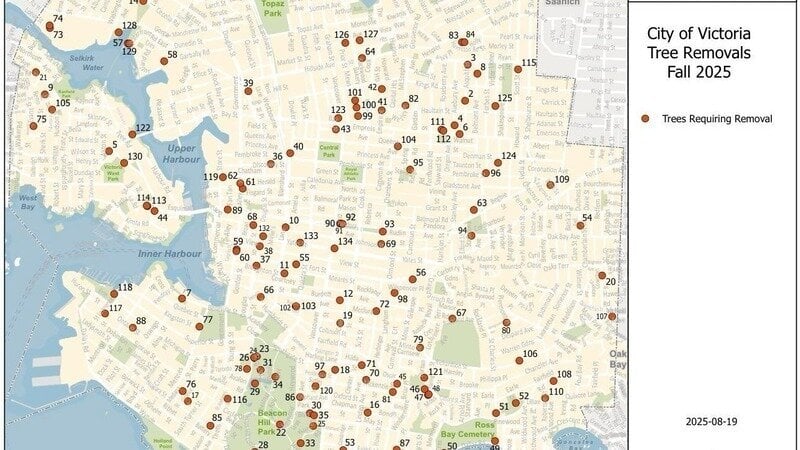
In 2025, 167 trees are slated for removal, with 133 scheduled to come down in the coming weeks. While removal is described as a “last resort,” the city states they plan to plant 350 new trees by year’s end—more than double the number being removed.
For residents seeking details, the city provides a list showing which trees are scheduled for removal, their species, and the reasons behind each decision:
According to the city, most of the trees set for removal are either at the end of their natural life or have structural weaknesses that could make them unsafe during the upcoming storm season.”
————————————————————————————————
As has been observed in the past, the City of Victoria’s claims that trees require removal, has deserved serious skepticism.
As the City of Victoria’s Assistant Supervisor of Urban Forestry Parks Urban Forest Services Ross Wilkinson put it several years ago: “There is no Hippocratic oath that relates to Arborists, or the practice of Arboriculture. While it is true that in some parts of the world Arborists are called Tree Surgeons, it is here that the similarity ends between the treatment of diseased trees and diseased people.”
All it seems is for the City to vaguely make it sound as if a tree needs or may need to go, and then they remove it, regardless if that was actually necessary or not.
The Sequoia issue showed that clearly, albeit public pressure has provided it an at least temporary reprieve from demolition.
————————————————————————————————
However, the City of Victoria is poised to remove vast amounts of trees, and its OCP update proposal also makes this apparent.
A coalition of residents asked for the Community Trees Matter Network to share the following information:
The planned update of Victoria’s Official Community Plan will significantly increase density. It will also result in increasing numbers of large, mature trees being removed throughout the city. And there will be less space for large trees to be planted and grow to maturity in future.
(For more info on the OCP, visit www.engage.victoria.ca)
The OCP will provide the framework and vision for development in Victoria from now until 2050.
If you are concerned about the loss of trees or other issues, consider participating in the public hearings on September 11th.
Four options to participate in the public hearing:
1) Speak in person. Maximum speaking time of five minutes. No registration required, staff will collect names in the order that people arrive at city hall. Meeting will take place in Council Chambers at Victoria City Hall, 1 Centennial Square, beginning at 6:30 p.m.. Come join us!
Showing up a bit early could save you a lot of time if you don’t want to stick around for the entire thing!
2) Speak over the phone. Registration opens August 29th, email publichearings@victoria.ca with your name and phone number. Maximum speaking time of five minutes.
3) Submit a pre-recorded video (max length 5 minutes). Email your submission to publichearings@victoria.ca. Submissions must be received by 2PM on Tuesday, September 9th.
4) Submit a written comment to publichearings@victoria.ca. Submissions must be received by 2PM on Thursday, September 11th.
For more details, scroll down on this page.
Backgrounder
Massive Rezoning: Too big. Too tall. Too much. Too fast.
• Provincial legislation calls for “small-scale multi-family housing of 3 to 4 units” in residential areas.
• The OCP update will allow 4 storeys anywhere and up to 6 storeys in Priority Growth and Local and Community Village areas. Higher buildings of up to 12 storeys will be allowed in Community Villages if there is “public benefit”. High rises of up to 18 storeys will be allowed in areas designated as Town Centres. (See City’s website at engage.victoria.ca/ocp )
• Some neighbourhoods like James Bay are rezoned predominantly up to 6 storeys.
• The City’s housing targets are unrealistic and significantly exceed projections from BC Stats as to population growth as a result of federal immigration policy changes.• See map below of proposed rezoning.
Urban Forest at Risk: Development overrides tree protection & threatens canopy growth.
• The proposed increase in density increases the incentive for developers to cut down trees and destroy green space to maximize density, building footprints and developer profits.
• New urban design concepts like minimized setbacks and “perimeter blocks” compete with existing trees and will result in their removal.
“Blue/Green networks”, “linear parkways” and private courtyards with newly planted trees cannot compensate for the loss of existing mature trees.
• The City has not strengthened the Tree Protection Bylaw to better protect existing trees, or to require development alternatives and ensure that tree removal is a last resort.
• The City has finally incorporated targets for tree canopy coverage into the OCP. However, the proposed targets do not appear to be based on achievable urban forestry best practices. Targets are also inequitable with 50% targets reduced to 25% in denser residential areas. Neighbourhoods have no input into the tree canopy targets in their area.
Some Urban Forest Policy Recommendations
Strengthen and enforce the Tree Protection Bylaw to stop routine destruction of trees on both public and private land. Develop achievable tree canopy targets based on urban forestry best practices and equity amongst neighbourhoods.
Require developers to consider alternatives to tree removal and ensure that tree removal is a last resort.
Develop achievable tree canopy targets based on urban forestry best practices and equity amongst neighbourhoods.
It’s important to know what we have. Measure progress toward canopy targets, publicize LiDAR vegetation change detection metrics for Zoning Modernization Areas, neighbourhoods, and City-wide, each 4-year period that LiDAR vegetation surveys are updated. Adopt a City-wide Garry oak species detection as part of ongoing urban forest remote sensing updates.
Ensure that Tree Reserve Funds, collected from developers who cannot replace trees, are applied where they are most needed. Create an Urban Forest Technical Advisory group with representation from community enviro, non-profit orgs, ecologists, biologists, and urban forestry experts including representatives specialized in urban arboriculture and Garry oak ecosystems.
Large tree species are important for climate adaptation and public health. A 6-m backyard setback doesn’t do enough to retain existing off-property trees near the property line, as well as trees outside of the building envelope, and substantially limits soil volume and above-ground growing space for large-at-maturity replacement trees. It also makes the “Minimum Required Trees Per Lot” excessively difficult to achieve when spacing requirements in the Tree Protection Bylaw (21-035) are applied.
Therefore, increase all setbacks by a minimum of 2m for Landscape area/Plantable space (i.e., soil area for planting a large species of tree) in the Priority Growth and Residential Infill Zoning Areas.
75% of the urban forest exists on private property
There has been no mapping and analysis of the overall Garry Oak Ecosystem or individual Garry oak trees on private property City-wide in over 20 years.
The new land use class scheme was determined without a City-wide biodiversity assessment on private property, presenting an obstacle to stewardship and conservation.
The tree canopy targets for Priority Growth residential zones (dark yellow) are only 25%, compared to 50% for Residential Infill zones (light yellow). This represents an inequity, for example, greater flood and associated property damage risk and an increased risk of heat-related illness for residents in the Priority Growth residential zone.
Section 488(1) of the Local Government Act: Form & Character Development Permit Areas (DPAs) for all new housing: Include requirements for a) protecting the natural environment, its ecosystem and biological diversity. However, the General Urban Design guidelines were crafted by the construction industry in the absence of an Indigenous land manager, or licensed ecologists, biologists or foresters.
Tree Protection Bylaw (21-035) has not been updated since Bill 44, and the Draft OCP, and cannot provide physical protection for existing trees when trees are located within a proposed building envelope.
————————————————————————————————
Tree-related articles:
– Sequoia tree spared for now as some funds for Centennial Square overhaul are diverted.
– Without more trees, BC’s next heat dome could be even deadlier
– When heat and drought stress trees, the consequences can be tragic
———————————————————————————————
For more information, please contact treesmatternetwork@gmail.com
Thank you again for all of your crucial support, and please provide in put on the new proposed City of Victoria OCP by Sept 11!
The map indicates “trees requiring removal”. I presume “requiring” means not enough soil volume for tree roots due to increased proposed density on the lot. There were two large horse chestnuts spared on the boulevard at 902 Foul Bay, but just recently, and after the completion of construction on the site, one of the chestnuts which had survived the surrounding construction, was removed. 18 bylaw-protected trees had already been removed from that particular site. The arborist was quick to offer apologetically that a large English holly had been saved on the southwest corner of the lot. Well, “Hey, thanks” I said to him–English holly is a highly invasive, introduced species with roots like steel, that many of us engaged in the preservation of Garry Oak meadows struggle to eradicate.