
Courtesy of the Times Colonist
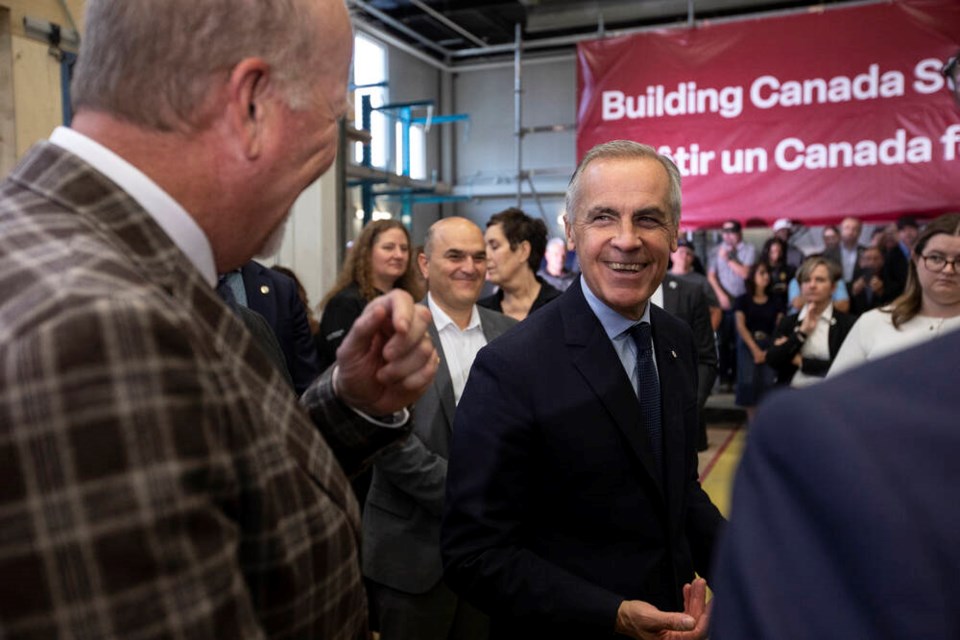
Photo: Prime Minister Mark Carney at an announcement of five major projects last year. Trevor Hancock writes that Carney’s government has rolled back action on climate change by getting rid of the consumer carbon tax and the EV sales mandate, while at the same time supporting increased tar sands and LNG extraction and promising public funding for new pipelines. AMBER BRACKEN, THE CANADIAN PRESS
Everyone is applauding Mark Carney for standing up for Canada in the face of Donald Trump’s assault on us.
And of course we need to do that.
But Carney’s strategy — doubling down on “a series of nation-building projects in energy, in trade, critical minerals, transport, data, and beyond,” as he noted in an April address — is simply an acceleration of “business as usual,” a model of resource extraction and industrial development firmly rooted in 19th- and 20th-century thinking about the economy and nature.
However, it is business as usual over the past century that has brought us to the brink of the ecological precipice.
The latest Planetary Health Check report, just out this week, confirms we have already crossed planetary boundaries for seven of nine vital natural systems and the trends for all seven are headed in the wrong direction.
So the last thing we need is an approach that says we can keep growing our economy, our use of resources, our creation of pollution and wastes and our impacts on the Earth’s natural systems within the finite system that is our planet.
That is an approach that led Kenneth Boulding, a former president of the American Association for the Advancement of Science, as far back as 1973, to remark to the U.S. Senate that “Anyone who believes exponential growth can go on forever in a finite world is either a madman or an economist.”
Well, our prime minister is an economist.
So it is disturbing to see the consistent pattern of environmental “ignore-ance” in the Carney government’s agenda.
The Throne Speech 15 months ago, titled “Building Canada Strong: A bold, ambitious plan for our future,” made no reference at all to sustainable development.
It mentioned the environment only once, in a throwaway line about “upholding Canada’s world-leading environmental standards,” which the government has since been systematically undermining.
We have seen the government roll back action on climate change by getting rid of the consumer carbon tax and the EV sales mandate, while at the same time supporting increased tar sands and LNG extraction and promising public funding (i.e. subsidies) for new pipelines.
Carney has said he wants Canada to be a superpower in both conventional and alternative energy, but as Dr. Courtney Howard, chair of the Global Climate and Health Alliance, remarked in her opening plenary talk at the Victoria Forum last month, it’s not enough to be an energy superpower. We should be a GOOD energy superpower, and doubling down on fossil fuels is the wrong approach.
Meanwhile, the government is proposing to relax other environmental safeguards in the interest of major projects of national importance.
Noting that the Building Canada Strong Act amends five federal laws, including the Impact Assessment Act, Species at Risk Act and Fisheries Act, Lisa Gue, national policy manager at the David Suzuki Foundation, said this past week: “Ottawa’s move to streamline regulations is code for steamrolling nature protections.”
So yet again, I point to the deep truth underlying the 2014 statement from the World Wide Fund for Nature, a deep truth Carney and his supporters either do not, cannot or will not understand: “Ecosystems sustain societies that create economies. It does not work any other way round.”
So sadly, but also disastrously, Carney’s real legacy will not be a stronger Canada but a dangerously weakened Canadian and global ecological system. Fundamentally, the government’s approach is ecocidal.
In 2021, a panel of legal experts from around the world defined ecocide as “unlawful or wanton acts committed with knowledge that there is a substantial likelihood of severe and widespread or long-term damage to the environment being caused by those acts.”
Who can doubt that the wanton and deliberate act of expanding fossil-fuel use, or any of the other policies that contribute to further transgression of planetary boundaries, is ecocidal.
The Carney government needs to rethink its entire approach to building a Canada fit for the 21st century.
We need a Canada that — in the interests of current young people and future generations — pivots to put the planet ahead of economic growth, that commits to living within planetary boundaries and to equitably sharing our already immense wealth.
thancock@uvic.ca
Dr. Trevor Hancock is a retired professor and senior scholar at the University of Victoria’s School of Public Health and Social Policy