
Courtesy of the Times Colonist
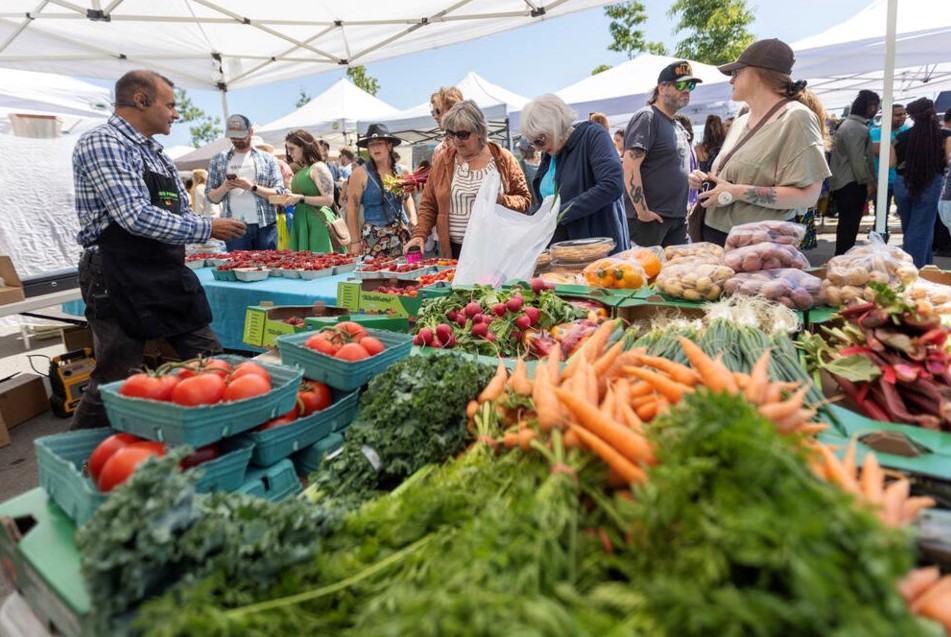
Photo: Vegetables sold at the Gobind Farms booth during FernFest in June 2025. Trevor Hancock writes that a national food strategy should have something to say about the nutritious quality of the food that is consumed. DARREN STONE, TIMES COLONIST
The UN’s Food and Agriculture Organization describes an agri-food system as encompassing everything from “field to fork.”
Unfortunately, Canada’s new National Food Security Strategy fails to pay much attention to either the field or the fork end of the system.
At the field end, noted Professor Asim Biswas, Canada research chair in digital agriculture at the University of Guelph, in an article in the Globe and Mail on July 6, the strategy “has little to say about the ground in which that food is grown,” adding that “a food-security strategy that omits the soil has overlooked the one thing on which all the rest depends.”
Moreover, as I pointed out in my July 12 column, there is an almost complete absence of any reference to the environment in the strategy. So we have a food strategy that doesn’t mention the most fundamental underpinning of our food security, our environment, including the soil.
Nor does the strategy do any better at the fork end of the system. You would think that a national food strategy would have something to say about the nutritious quality of the food that is consumed and the meeting of dietary needs to enable a long and healthy life.
After all, a 2023 article in the American Journal of Epidemiology found that in Canada “poor dietary pattern is the leading risk factor for loss of life years at the national level,” contributing to between 27 and 39 per cent of all deaths in men, and between nine and 23 per cent of all deaths in women.
Yet astonishingly, none of that is apparent in the Carney government’s approach to food security, which displays an almost complete disregard for a healthy diet.
Diet is only mentioned once, and in passing, in their 27-page document, where it is noted that because of climate and agricultural specialization “not enough fruits and vegetables are produced year-round to meet the full dietary needs and recommended consumption levels of Canadians.”
No mention of the unhealthy levels of fat, salt, sugar and red meat in the average Canadian diet, never mind ultra-processed foods.
Indeed, health itself is only mentioned eight times, mostly in a recurring phrase about protecting the health and safety of our food. But bizarrely, half of those references are found in suggestions to reduce the regulatory burden and thus the costs to the agri-food industry, a position that seems to have been championed by the industry itself.
Even worse, Canada’s Food Guide, issued in 2019, is also only mentioned once and in passing, where it is suggested that “based on Canada’s Food Guide, the domestically-produced share of healthy food available to Canadians will increase from 75 per cent to 85 per cent, by 2032.”
Well, that’s fine, but shouldn’t the fundamental aim of the entire agri-food system be to produce a healthy diet, based on Canada’s Food Guide?
It seems the government is ignorant of — or is choosing to ignore — its own policy initiatives and expertise.
The government could have looked to the 2019 Food Policy for Canada, which set out “a framework to align and coordinate federal food-related initiatives … to improve social, health, environmental and economic outcomes.”
It could have used the Canada Food Guide as a goal. It could have consulted with its own Canadian Food Policy Advisory Council, which was established in 2021 — except that it has not met nor had new members appointed since 2023.
As Biswas pointed out, it could have linked its food security strategy to the National Agricultural Soil Health Strategy that Agriculture Minister Heath MacDonald committed Canada to in March 2026.
But not one of these is mentioned in the strategy.
Frankly, the strategy comes across as an amateurish report cobbled together by people with a narrow economic understanding of food security — as one might expect from a government headed by an economist.
But a national food security strategy that pays scant attention to either field or fork or to the government’s own policies and recommendations is not worth the paper it is written on.
The Carney government should try again, this time by talking to people who actually understand the full depth and breadth of food security.
thancock@uvic.ca
Dr. Trevor Hancock is a retired professor and senior scholar at the University of Victoria’s School of Public Health and Social Policy