
Introduction
If you think of capitalism as the global entanglement of everything financial and economic, then for sure, it feels like a pretty wild dream to imagine that we could disentangle it all and establish something different.
It is a pretty wild dream, because the entanglement includes some 350 million businesses, 100 million corporations, 75,000 multinational corporations, 25,000 banks, 3,000 billionaires, millions of investors and shareholders, two million economists, and all the bond markets, commodities markets, futures markets, stock exchanges, global trade, and a thousand other things. Amazon alone sells 600 million different products.
These things operate together in a market economy that is extraordinarily effective in the delivery of goods and services – as long as we ignore the harm imposed along the way to nature, workers, and communities, and the way it is causing the climate crisis, which could derail our entire existence on this small, beautiful planet.
But capitalism is NOT that entanglement.
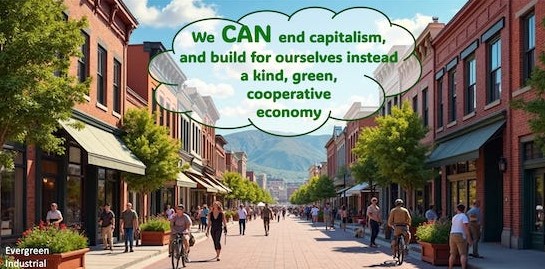
Except for the billionaires, there is nothing in that paragraph that is inherently capitalist. Each of those items could flourish in a kind, green, cooperative economy.
So what IS inherently capitalist?
When we look at the long stretch of history, captured so richly and magnificently in Sven Beckert’s Capitalism – A Global History (Penguin, 2025), one thing stands clear. It is that capitalism was created by and is driven by the agency of people who are uniquely selfish in their desire to accumulate capital. In pursuit of this goal they seek to dominate every political system that allows it, and kowtow to any that doesn’t. And nothing is off the table. Historically, capitalists have been able to accommodate slavery, conquest, colonialism, fascism, Nazism, democracy, even communism.
One of truths that emerges from Beckert’s book is that capitalists have always depended on governments to support and enable their activities, so ending capitalism also requires ending the multiple ways in which governments give that support.
Capitalists have no real ideology, except to claim that they have one through ‘free market economics’, or the ‘laws of economics’, which provide a persuasive smokescreen for their selfishness. Their ideology is simply personal gain through the accumulation of capital, while ignoring the social and ecological costs.
These things are NOT true of most business owners, whose primary concern is to provide a product or service their customers want to buy, and whose secondary concern is to generate a profit.
By ‘capitalism’ I do not mean markets, trade, entrepreneurship, and business. I mean the specific ways in which capitalists use whatever economic system they are in to maximize their capital accumulation, while ignoring the human, social and ecological realities.
Ending capitalism does not require closing down the market economy, or taking 350 million private businesses into public ownership. So what does it require?
1. Believe that it is Possible
First, it requires that we believe that it is possible. Ever since Johannes Gutenberg invented the printing press, enabling people to think for themselves, people have been standing up to say NO to oppression, NO to the rule of kings and priests, and NO to feudalism, slavery, and exploitation.
For 300,000 years our ancestors managed to live cooperatively, suppressing those who tried to dominate. With the coming of food surpluses, however, some families began to accumulate wealth they did not want to share, and over time, they insisted that their children should inherit their wealth and titles, as the anthropologists Kent Flannery and Joyce Marcus reveal in The Creation of Inequality: How Our Prehistoric Ancestors Set the Stage for Monarchy, Slavery, and Empire. In this way, they ended 300,000 years of cooperation and ushered in 5,000 years of kings, conquests, and cruelty.
Wealthy self-important people always want to dominate. It is second nature to them. They think they are better than the rest of us, that they are entitled to rule over us. When the printing press enabled people to think for themselves, however, the pushback began.
In 1648, the English cut the head off their king, beginning their long stumble towards democracy. In 1789, the French cut the head off their king, beginning their stumble towards the same goal. In 1848, people all across Europe rose up to challenge their kings and rulers. In 1917, the Russian overthrew their Tsars, but in their stumbling they fell into a pit of communist cruelty, remaining there until 1989.
Throughout the 19th and 20th centuries working people dreamt of the day when they would no longer be subject to cruelty, exploitation, poverty and oppression. To this end, they created trade unions, workers cooperatives, retail cooperatives, public banks, community banks, cooperative insurance companies, and so much more. They also created democracies. For the first time in 5,000 years, they had the ability to remove a bad government without needing to chop its leaders’ heads off.
In Barcelona today there are over 5,000 non-capitalist social purpose economic organizations. In Quebec, there are 11,200. In Kerala, India, there are 317,400 Kudumbashree groups where the women decide the future of their village and neighbourhood economies. In Mondragon, Spain, the Basque people have built an entire network of cooperatives, many in manufacturing. None of these initiatives is capitalist, even though they exist within a capitalist economy. They have been created by people whose ethics are those of cooperation and kindness, not selfishness and greed, yet they still express creativity, initiative, innovation, and risk.
We need know with 100% confidence that it is possible to replace with a people-centred cooperative economy, in which we also cooperate with Nature.
Our work is not to despair, but to pick up our courage and complete the journey our ancestors started. This is unlikely to be an overnight achievement. More likely, it will be a thousand changes, transforming our economies step by step, business by business, bank by bank, community by community – but with effort, inspiration, and collective support, we could achieve it within ten years.
2. Choose a Clear Purpose
For most capitalists, their purpose is to maximize their personal wealth. To make this politically palatable, they cover it with the claim that they are increasing GDP, from which everyone will benefit. The claim is nonsense. Every car crash, every divorce and every rainforest destroyed increases GDP.
How should we choose our collective purpose? A government that was elected by fair proportional voting might establish four or five regional Citizens’ Assemblies, each with 50 people chosen by lottery. They would meet over three weekends to listen to different experts, and decide what they thought should be the nation’s priorities for the next 25 years. Their recommendations would be shared in a multiple-choice referendum, and everyone would be invited to vote.
I doubt that “increasing GDP” would make the list. It is more likely that we’d see goals such as “End poverty”, “Ensure there are jobs for all”, “Make life affordable”, “Tackle the climate crisis”, “Build a green cooperative market economy”, “Help our young people”, and “Build a new ecological civilization”.
The chosen goals would then inform policymaking during the government’s time in office.
3. Build Community Wealth
In the economy it includes cooperatives, public banks, community banks, benefit corporations, social enterprises, employee-owned businesses, community currencies, the community ownership of assets, housing cooperatives, cooperatively owned mobile home parks, community investments, community development corporations, and the firm rejection of private equity’s incursions. Increasingly, cities like Preston, Lancashire (UK) and Cleveland, Ohio, are bringing the pieces together to weave the fabric of local economic cooperation. The region of Emilia-Romagna, in northern Italy, has been doing it for over a century. In Finland, cooperatives account for 20% of their GDP, and a lot more of their Gross National Happiness.
To make these things the norm our governments should do as Scotland has done with its Community Wealth Building Act, approved unanimously by the Scottish Parliament in February 2026. The Act requires that every local government and public body in Scotland develop an action plan to support the generation, circulation, and retention of wealth in the local economy, strengthen local ownership, use procurement as a local economic engine, support good jobs and fair wages, align capital with community agency and benefit, and treat land and buildings as shared assets. In this way, villages and towns can retool the everyday mechanics of their economies so that value circulates locally, instead of being extracted by capitalist investors.
In the first of our ten years, we will need to learn what community wealth is, write Community Wealth Building Acts, and get the legislation passed.
4. Invite Every Business to Adopt a Social Purpose Charter
For most businesses, the primary goal of their owners and workers is to make or deliver a product or service people will want, be it a tavern that sells ale or a factory that makes cars. Other goals may include not harming nature, and treating their workers well. Making a profit is not the only thing that matters.
In the first of our ten years, we need to legislate an Act that will invite every business to adopt a Social Purpose Charter in which it would state its social purpose and commit to a range of other things, including annual reporting on steps to reduce its impacts on nature and the climate, support for labour unions, the inclusion of women and workers on its board, a commitment pay taxes fairly, and various other things.
The urgency of the polycrisis means that signing on cannot be voluntary. We need every business to adopt a meaningful purpose, and to behave with decency, as most businesses already do. To enable this, we need a ten-year transition.
During the transition, every business that adopts the charter would get priority when bidding on government contracts, pay a lower rate of corporation tax, and have access to lower interest rates. After five years, companies that had not adopted the new charter might be denied access to government contracts, and pay a higher rate of corporation tax, and a higher rate of interest on bank loans. By the end of the transition, if a business had not adopted the new charter, it and its subsidiaries would be denied license to operate.
This will generate enormous resistance from the billionaires and right wing think tanks, but most people – 72% in America, 82% in the UK – support policies like this. I would guess that 98% of businesses would have no problem adopting a social purpose charter.
It’s the 2% we need to be concerned about. Some companies would resist, litigate, and attempt to evade the rules. They would switch their head offices to other countries, but they would be denied commercial activity in their home country, so the pressure from employees and shareholders would be huge.
The same legislation would apply to businesses that import goods or services. After ten years, they too would need to adopt the new charter.
5. Build a Green Cooperative Banking System
Money and banking are too important to be governed by speculation and private accumulation. In a kind, green, cooperative economy, finance would be a public service whose prime purpose would be to support businesses, jobs, community, and ecological recovery.
Successful role models for this include 67,000 credit unions, with $3.8 trillion in assets; 1,000 public banks, holding 20-25% of all global banking assets; members of the Global Alliance for Banking on Values including Triodos, Banca Etica and 68 others, with $265 billion in assets; and 10,000 cooperative banks, community development banks, and Islamic ethical finance banks. Together, they hold $60-$75 trillion in assets. That’s 30% to 40% of global banking assets of $190 trillion, excluding the shadow banks. So clearly, this is possible.
Social purpose banks are just as profitable and more financially resilient than private banks. In the 2008 financial crisis, when the big banks were pleading to be bailed out with public money, European cooperative bank assets grew by 10%. Their customer base grew by 14%, and only 7% suffered losses, most of which were made up within two years. No public bailouts were needed. The vast majority of credit unions needed no help, and America’s 7,600 community banks remained the best capitalized, since their managers had not taken excessive risks. Between 2007-2010 their assets grew by 10% and their customers and reserves grew by 14%. Between 2003 and 2010 the average return for cooperative banks was 7.5%, compared to 5.7% for investor-owned banks. What’s not to like?
There are four ways in which we could wean the banks off capitalism. The first is requiring them to adopt the social purpose charter.
The second is to establish a legislated ‘red-amber-green’ taxonomy that would state which investments are encouraged, which require caution, and which are banned. The red category would include investments in fossil fuel extraction, in the large-scale destruction of nature, in industrial cattle ranching linked to deforestation, and initiatives with appalling labour conditions. Investing in fossil fuels in 2026 should be as unthinkable as it would have been to invest in selling tanks to the Nazis in 1939.
A list of candidates for the red list could be drawn up, and a Citizens Assembly with 50 randomly selected people could recommend what should be on it and what not, removing decision-making from politicians and lobbyists. Pension funds could be required to phase out all of their red-listed investments within a year of the list being published, and to redirect their investments into climate solutions, affordable housing, ecological restoration, public transit, community wealth creation, and the green economy.
The third way involves the central bank. Central banks are unique institutions. Like the regular banks, they have the power to create money and add it to the economy, but they do not add it as a loan. They create it as a gift. Whenever an economy can absorb the new money, when there are unemployed workers and unused resources, this will not cause inflation.
Central banks could use this power to underwrite loans on the green list, reducing the interest rate to zero or 1%. This would likely include investments in climate solutions, ecological farming, affordable housing, community wealth, and a zero-waste circular economy.
The fourth way is that a government could create climate solutions bonds, nature restoration bonds, and affordable housing bonds, and the central bank could create the money to buy them, on the premise that they are tackling an emergency condition that requires such intervention. In this way, money to tackle the climate, biodiversity and housing crises would not need government borrowing.
This would require that central banks cease being independent, and fall under democratic governance. They could be subverted by Trump-like Presidents or Prime Ministers, but risks like this accompany all democracies. Instead of using interest rates to control inflation, governments would use taxation, adding money to the economy when it is lagging and taking it away when it is needs cooling down.
Then there are the shadow banks and non-bank financial institutions, which hold some $250 trillion in assets. They create The Global Casino, as the economist Ann Pettifor calls it. Weaning them off capitalism will require global cooperation, since they are offshore eels, perpetually wriggling out of regulatory nets. Left untouched, they will continue to overwhelm democracies, wielding more power than elected governments. We will need international agreements to prevent capital flight, end tax avoidance, require banking transparency, control speculative finance, and establish ecological standards.
None of this is new. During World War II, and in the postwar era, governments routinely directed finance toward national priorities. China used methods like these to achieve unprecedented economic development. The idea that markets alone should decide where investments should go it is ethically empty.
6. End the Inequality Craziness, and the Anger it Generates
Capitalists love these numbers. It shows that the system is working the way they want. In 2019 Warren Buffet had a net worth of $84.4 billion. By 2022 it had risen to $118 billion – a gain of $30 billion in three years, $30 million a day.
In 1979, the average American had to work 30 weeks a year to pay for their house, car, health care, and education. Today, they have to work for 53 weeks. As a result, 50% to 60% of Americans live paycheck to paycheck with minimal or no savings, but a huge burden of worry and stress. In Britain, the 50 richest families hold more wealth than the entire 34 million people in the poorest half of the country.
If there had been a 2% wealth tax on the 0.001% wealthiest people, starting in 1990, it would have raised £6 billion a year. Invested, by now it would be worth some £325 billion, £11,000 per household.
What could a government with a strong public mandate do to restore justice? We need a New Social Contract, because the old one is no longer working. What might it include?
Fair taxation. Wealth taxes, inheritance taxes, and a higher tax rate on incomes above $250,000 a year. Maybe an extreme wealth tax of 100% on incomes over $10 million, sending a signal that extreme wealth is no longer tolerated. At the same time, upping the threshold before you need to pay tax, lifting the burden off lower-income people. Low-income families could also benefit if governments expanded child tax credits, an idea that’s supported in America by a majority of Republicans.
We need to eliminate the tricks wealthy people use to avoid paying taxes, such as leaving your capital intact and borrowing against it for income, writing off the interest as a tax-deductible expense.
Secure Work. A government with a strong public mandate could ensure that everyone who wanted a job had one, and remove the fear that AI is going to take people’s jobs:
· It could guarantee the right to form a union, enabling working people to work together to achieve higher wages and better working conditions.
· It could require larger companies to give their workers 51% of the seats on the board, as in Germany.
· To head off the AI jobs apocalypse, rather than laying off workers it could require a reduction in working hours to 3 or 4 days a week.
· It could ban compulsory mass lay-offs in any company that received a government contract or support, and require lay-offs to be voluntary, accompanied by a financial package, as Les Leopold has proposed.
· It could ban all lay-offs associated with AI, as a court in China has ordered.
· It could establish an AI Sovereign Wealth Fund, imposing a one-time 50% tax on the stock of OpenAI, Anthropic, and other AI companies, enabling the dollars generated by AI to be used improve the lives of all, as Bernie Sanders has proposed.Hisargument is that since AI is built on the knowledge, creativity, conversations, and labor of the American people, they deserve a cut of the profits.
· It could adopt Denmark’s system of ‘flexicurity’, giving employers the flexibility to hire and fire according to their needs, while protecting workers with generous unemployment pay, paid training, and assistance in seeking a new job. Around a fifth of Danish workers lose or change their jobs in any given year, but thanks to flexicurity, most find a new job quickly.
· It could finance locally-organized job guarantees for anyone who has been out of work for a year, as the Austrian town of Marienthal is doing, with positive results, funded by a tax on AI units, as Elizabeth Warren has proposed. In the UK, 72% of peoplesupport a job guarantee like this. In the US, it’s 78%. In France it’s 79%.
Universal Basic Services. A government with a strong public mandate could legislate a goal to achieve Universal Basic Services for all within ten years. Not Basic Income, which would soon disappear through inflated rents, childcare costs, and so on, but basic services: guaranteed affordable housing, childcare, seniors care, transportation, and broadband.
Baby Bonds. A government could use the income from inheritance taxes to give every baby $1,000 every year on its birthday, rising to $2,000 for babies in the poorest families. The funds would sit in an account managed by the Treasury, and earn 3% a year. At age 18 or 21 it could be withdrawn for a list of permitted uses. The bonds for a child from a poor family might grow to around $46,000. In Spain, deputy Prime Minister Yolanda Díaz has proposed something similar, giving every young person €20,000 once they reach 18.
Debt Resolution. By 2023, household debt in America had reached $16.9 trillion, with proportionally similar sums in Switzerland, Australia, Norway, Canada, South Korea, New Zealand, Sweden, and the UK. In Britain, lower-income people owe £16 billion to the government for things like council tax arrears, benefits advances, sanctions, and tax overpayments. Christians Against Poverty found that 93% of its clients with debts had sleepless nights, 74% were scared to open the door, and 49% were scared to leave the house. This is the economics of cruelty, not kindness. What can be done?
A government with a strong popular mandate could cap interest rates, and develop formulas to forgive student debt, medical debt, and credit card debt. It could finance a Fair Debt Write Down, spending $6 billion to buy $30 billion worth of chronic debt on the secondary market. This would write down the debts of 4.3 million people, who would repay them at 20% of their face value using debt management plans formulated by a non-profit agency. This would return the $6 billion to the government and enable the process to be repeated. Governments could help the advisory agencies that help debtors consolidate their debts. They could pay their costs, and create zero interest loan funds to enable debt consolidation.
7. Protect Nature
- Protect far more land and water, pursuing the goal of 30% by 2030 and 50% by 2050.
- Replace GDP with Ecological Civilization Progress as the nation’s measure of progress.
- Engage children in nature education from age 5 onwards.
- Make ecocide – the destruction of nature – a criminal offence.
- Ban investments in red-listed activities.
- End all subsidies for ecologically destructive activities.
- Strengthen enforcement and penalties in existing legislation.
- Require every large company, and every landowner with more than 100 acres, to report annually on their impact on nature and the climate, and the steps they are taking to reduce it.
- Ban the import of products linked to deforestation and other harmful activities.
- Appoint a Commissioner for Nature to review all major legislation and investments.
- Negotiate ecologically oriented trade agreements, and remove Investor-State Dispute Settlement clauses that prioritize investors over nature.
- Levy a circular economy tax on all products, falling to zero for those that are fully recyclable. Return the revenue to people as a rebate.
- Work with Indigenous people to protect nature, recognize their rights, law, and land, and receive their free, prior, and informed consent for major developments that affect their land.
- Create a Nature Restoration Corps for young people who want to restore forests, wetlands, rivers, farmlands and grasslands.
- Reward farmers who reduce farmland pollution and restore ecosystems, and penalize those who don’t.
- Work with local governments to turn urban areas into oases of greenery.
- Create Citizens Assemblies to recommend further ways to protect nature.
8. Restore Climate Stability
1. Speak out loudly and publicly about the dangers the climate emergency has created, and the path to a climate-stable world.
2. Require climate solutions education in all schools, colleges, and public agencies, including civil servants, as France is doing.
3. Ban new investments in fossil fuels, and other climate-destructive projects.
4. Ban fossil fuel advertising, as The Hague, Amsterdam, Arnhem, Stockholm, Genoa, Florence, Copenhagen and other cities have done, including advertising for cruises, conventional cars, and planes.
5. Aim to achieve a full transition off fossil fuels by 2040, with parallel goals to electrify vehicles and building heat.
6. Implement a steadily rising carbon tax, returning the income to families as monthly rebate cheques, with lower-income families gaining more from the rebates than they pay in tax.
7. Work with other nations to sign a global Fossil Fuels Non-Proliferation Treaty, and an agreement to transition off fossil fuels.
8. Work with the central bank to create the money needed to underwrite climate solutions loans.
9. Encourage the formation of public banks in every region, creating the loans needed for climate solutions.
10.Form public corporations to pursue aspects of the transition off fossil fuels that the private sector is unwilling to address, such as building retrofits, and the manufacture of low-cost heat pumps.
11.Work with farmers and the public to transition off cattle, and chemical farming.
9. Solve the Housing Crisis
1. Require all levels of government to work together to build the millions of units of cooperative and non-market housing are needed, within ten years. This would phase out the need for most private landlords, replacing rental properties with public and cooperatively owned homes.
2. Ban the purchase of homes by speculators and private investors. In Berlin, where 84% of households rent, the city voted in 2019 to buy 15,000 apartments from two large corporate landlords and put them in public ownership. In a subsequent referendum, yet to be acted on, Berliners approved buying a further 240,000 homes, which would 15% of all housing into public ownership.
3. Give tenants, community organizations and mobile park residents the right to buy their homes from their landlords, supported by legal advice and zero-interest loans, underwritten by the central bank.
4. Increases taxes and penalties on second and third homes, and on empty homes, getting them back on the market or into public hands.
5. Tax increases in the value of the land above $100,000, payable when the land is sold, rising to 80% for second homes and 100% for third homes, with exemptions for low-income owners, and protection against forced sales.
Far more is needed, but this shows what’s possible. Many landowners would strongly oppose reforms like these, but with skill, compromise, and cooperation, a smooth exit from ownership could become possible. In the 1970s, Sweden built a million units of affordable housing, borrowing the money at low interest. Today, 23% of Sweden’s housing is cooperative. In Austria, every sixth person lives in an apartment that’s affiliated with a limited-profit housing association. In a kind, green cooperative economy, all this becomes possible.
10. Coordinate Fiscal and Monetary Policy
Monetary policy in a capitalist economy determines how the central bank uses interest rates to control inflation, and how it creates public money to bail out the banks and corporations when their gambling fails, and to cope in an emergency such as a pandemic.
In a kind, green, cooperative economy, by contrast, fiscal policy is how the government manages its taxation, spending, investments, and borrowing while knowing that a nation that controls its own sovereign currency can never run out of money. Economists would understand the reality that the government creates money every time it spends, backed by the central bank, and retrieves it by taxation, and that the rate of taxation can be used to control inflation and regulate demand.
In a capitalist economy, governments finance their spending through taxation and borrowing, and the central bank is supposed to be independent, though strongly influenced by financial-sector priorities and orthodox economic assumptions.
In a kind, green, cooperative economy, fiscal and monetary policy work would hand-in-hand. The governors of the central bank would be appointed by the democratically chosen government, taking the equivalent of a Hippocratic oath to serve the needs of the nation according to its chosen purposes.
The central bankers’ ability to create money is used to provide help during emergencies, which could include the climate crisis, the biodiversity crisis, and the housing crisis, as well as financial crises and pandemics. It would be supported by a network of public banks, one for each region. Like all licensed banks, they would create credit through lending, but they would issue the loans for socially and ecologically beneficial purposes. For every $1 million in the bank, they would be able to issue $10 million in loans.
Over ten years, reliance on the bond market to finance deficits would be gradually reduced, slowly eliminating the system by which investors earn interest by financing the government’s debt.
11. Include International Trade
It could widen the ban on trade in harmful products, which currently includes endangered species and wildlife products, conflict diamonds, persistent organic pollutants, and hazardous wastes.
It could impose fair trade and ecological footprint tariffs, as the German economist Christian Felber has proposed. Governments would agree on what constitutes “harmful” and levy tariffs accordingly, including border carbon tariffs on goods on which no carbon tax had been levied. Harmful goods would become more expensive, and the revenues could be used to help companies switch to greener products.
It could write due diligence laws, requiring companies to prove that imports are not linked to forced labour, deforestation, ecological destruction, or human rights abuses, as the European Union is doing to protect tropical hardwoods.
To reduce our manic rate of consumption it could remove consumer taxes from essentials and increase them on everything else, using a Citizens’ Assembly to determine what was essential and what was not.
It could create a Green and Red star rating for every product, based on its social harm and ecological footprint. Manufacturers would be required to display the ratings, and the products could be taxed accordingly. And far more.
12. Make It Happen
Firstly, we need a huge public movement to get people thinking, organizing, and mobilizing. We need to unite the myriad smaller movements for change into a single coherent movement, in which people can visualize the future they want and be motivated to work together to make it happen.
Secondly, we need to elect a government with strong enough support to make the necessary changes. The government will need to work hand-in-hand with the movement that got it elected, and not retreat into the basements of bureaucracy the day after the election.
We can dream about fair, representative, proportional democracies, participatory methods, and public referenda, but we are going to have to work with what we have got. This means becoming deeply engaged with the existing political parties, persuading them of the merits of abandoning capitalism in favour of a kind, green, cooperative economy.
And thirdly, we will need determined persistence in the face of the push-back from furious tycoons, who will call us communists, socialists, antisemites, pedophiles, dumocrats, whatever, and use personal attacks in their attempt to hold into power. They will not go down smiling.
We are not the first to hold this vision. For centuries, our ancestors had the same hopes. It was their determined hope that the next generation would continue the struggle. We are that next generation. There is no possible world in which we can leave this to the generation that comes after us. The urgency of the climate and ecological crisis demands that we do it now.
We can re-orient our economies towards kindness, cooperation, and wellbeing for all. Many of these ideas are popular, as Jason Hickel’s research has shown. They will still be market economies, and there will still be private businesses, alongside public, cooperative, and community businesses, but the overall purpose of the economy will be cooperative, seeking the wellbeing of all.
Nature included.