
Courtesy of the Times Colonist
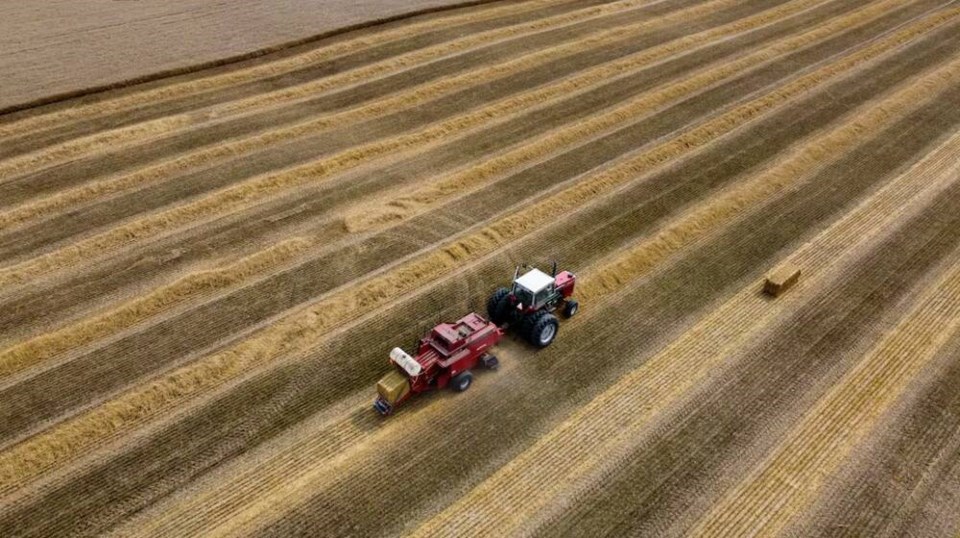
Photo: A farmer works in a field in Mississippi Mills, Ont. SEAN KILPATRICK, THE CANADIAN PRESS
The Carney government recently released its National Food Security Strategy.
Unfortunately, the strategy only serves to show that the government doesn’t really understand food security, particularly when it comes to the environment and health, neither of which figures much in the strategy.
I will discuss environmental neglect in this column and the neglect of health in a future column.
It should be glaringly obvious that ultimately, food security depends on a healthy environment, and that producing food in environmentally harmful ways undermines food security.
Yet not only does the word “environment” appear only 10 times in the 27-page strategy, eight of those times are not actually about the natural environment but about the technology of ‘controlled environment agriculture’, meaning greenhouses.
Nowhere in the strategy does it discuss how our current agri-food system harms the environment.
Yet the October 2025 second report of the EAT-Lancet Commission on a healthy, sustainable and just food system noted that when it comes to the transgression of planetary boundaries for many of the nine Earth systems that are vital for life on Earth, “food is the single largest cause of planetary boundary transgressions, driving the transgression of five of the six breached boundaries.”
Since then, we have crossed a seventh boundary, ocean acidification, to which agriculture also contributes.
Specifically, the commission reported, agriculture accounts for 85 to 90 per cent of total pesticide use and 73 per cent of total antimicrobial use, while it contributes around half to three-quarters of flows of nitrogen and phosphorus to surface waters, which cause algal blooms and dead zones.
Agriculture is also responsible for two-thirds of all freshwater use, while “Unsustainable land conversion, particularly deforestation, remains a major driver of biodiversity loss and climate change.”
In addition, agriculture contributes 30 percent of all human-generated CO2 emissions that cause global heating, and a quarter of the CO2 emissions that contribute to ocean acidification.
Good luck finding much of that in the National Food Security Strategy.
Pesticides are only referred to in terms of making it easier to use them, while antimicrobials are not mentioned at all. Nitrogen is mentioned once in passing, phosphorus not at all, and fertilizers only in terms of problems with supply and improving availability.
The word water, bizarrely, does not appear once in the report, nor does biodiversity or ocean acidification or — even more bizarrely — greenhouse gases or carbon/CO2 emissions.
Yet these environmental effects, to which Canada is a significant contributor, have a large and growing impact on food security. (The food security strategy notes Canada is “the world’s ninth largest exporter of agri-food products.”)
Climate change alone is a major concern, as a recent joint Food and Agriculture Organization/World Meteorological Organization report notes.
The combination of rising temperatures, heatwaves, drought and water scarcity represented a “systemic risk to global food security and to the livelihoods of more than 1.23 billion people who rely on agriculture.”
Yet the food security strategy only mentions climate change four times, and only in the context of it being one of “the global issues beyond Canada’s ability to directly control” that are impacting our agri-food system and increasing costs.
No suggestion here that Canada bears any responsibility for climate change or that it could do something about it by reducing the agri-food system’s greenhouse gas emissions.
Perhaps that is because the Carney government’s policies are moving Canada away from our climate change targets and are increasing our fossil fuel extraction and exports.
Add to that the impacts on food supply and food quality of ocean acidification, algal blooms and dead zones due to nitrogen and phosphorus pollution, as well as widespread use of pesticides and antibiotics, and food chain contamination with plastic nanoparticles, and it is clear that our current agri-food system creates environmental insecurity.
In a largely overlooked October 2025 speech, David McGuinty, the minister of defence, explained that “Our security and our prosperity are fully dependent on a healthy and functioning environment” before concluding that “Our national and natural security are inextricably linked.”
That certainly applies to our food security, but the new National Food Security Strategy disastrously fails to make that connection.
thancock@uvic.ca
Dr. Trevor Hancock is a retired professor and senior scholar at the University of Victoria’s School of Public Health and Social Policy.